When using the covered call writing strategy, it is critical to select stocks with positive price momentum. This will increase the probability of maximizing our profits. One of the technical indicators included in the BCI methodology is the stochastic oscillator.
The
stochastic oscillator is a momentum indicator that shows the location of the current closing price relative to the high-low range over a set number of periods, usually 14 trading days. Closing levels that are near the top of the range indicate
accumulation or buying pressure while those near the bottom of the range indicate
distribution or selling pressure. Another way to frame this is that it is the battle between the bulls and the bears and who is in charge. The indicator oscillates between 0 and 100. Readings below 20 are considered
oversold while readings above 80 are considered
overbought. The idea behind this indicator is that
prices tend to close near the extremes of the recent range before turning points.
Let’s set up an example as to how this works.
We will assume that during the past 14 trading days stock XYZ has seen a low of $30 and a high of $40. Today it closed at $38. Within the $10 trading range, the stock is $8 up or in the 80%. If the stock closed today at $32, it would be at the 20%. This is known as
%K in stochastic lingo. Transaction signals occur when %K crosses its 3-day simple moving average called
%D. This is also known as the
trigger line. Let’s look at a chart that shows the stochastic oscillator:
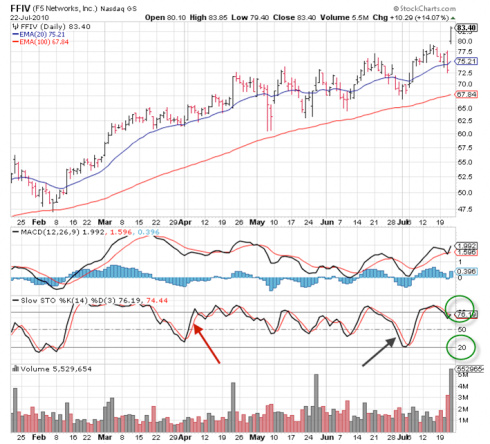
- Stochastic Oscillator Chart- Slow
Note the following:
- Stochastic oscillator = thick black line highlighted by the black arrow = %K
- Trigger line = red line highlighted by red arrow = %D
- Overbought (80%) and oversold (20%) levels are highlighted by the green circles.
Some chartists use crossovers of %K and %D as buy/sell signals. However, these signals occur quite frequently and can result in whipsaws or a myriad of short term signals. A more reliable reading (in my view) is when the oscillator moves from overbought (above 80%) to below that level or from below oversold (20%) to above that level. A strong stochastic signal occurs when the positive divergence above 20% or a negative divergence below 80% takes place for a second time or a double dip. Here are the guidelines:
Buy signal: %K crosses above the 20% for the second time
Sell signal: %K moves below the 80% for the second time.
In the chart below, we see a clear buy signal highlighted by the green circle and the price then accelerating as seen by the green arrow. There is also a definite sell signal highlighted by the red circle with the subsequent price decline shown by the red arrow.
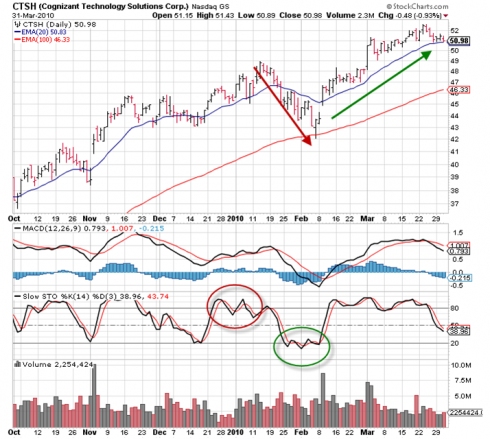
- Stochastic Oscillator- Buy and sell signals
:
One of the problems with %K in relation to %D is the high number of false breaks, whipsaws and crossovers. To mitigate this issue, the slow stochastic oscillator was developed. This is derived by applying a 3-day simple moving average to the %K thereby
smoothing the data to form a slower version of %K. An equation that can be used to visualize this would be:
%K (slow) = %D (fast)
Then to form a trigger line for this slower version, a 3-d SMA is created and applied to the new %K (slow).
When building a chart, there is usually a choice of selecting slow or fast stochastics. I always opt for the slow stochastic oscillator as it is easier to read and interpret and eliminates many of the false triggers inherent with the fast oscillator.
Full Stochastic Oscillator:
There is actually a third stochastic oscillator called full stochastics. Rather than being required to use the 3-day SMA of the %K as in the slow stochastics, traders felt that this should be a variable so more flexibility could be achieved. A third variable was created called the
smoothing variable which alters the amount of days used in the smoothing of %K. One can also recreate the fast and slow stochastics by the full stochastic. To mimic the fast stochastic, use a 1-day smoothing number. To mimic the slow stochastic oscillator, use a 3-day smoothing number.
Conclusion:
For purposes of 1-month covered call writing, I have found the slow stochastic oscillator most useful and time efficient. It is a widely used momentum indicator that measures who is winning the daily battle between the bulls and the bears. As always, it is prudent to
use this oscillator in conjunction with our other technical indicators. See chapter 8 of
Cashing in on Covered Calls or chapter 4 of the
Encyclopedia for Covered Call Writing for a review of all technical indicators used in the BCI system.
Market tone:
We’re off to a great start in 2012…all positive economic reports:
- The US economy added 200,000 jobs causing the unemployment rate to drop to 8.5%, the lowest level since February, 2009.
- In December, the ISM manufacturing index rose from 52.7 to 53.9
- The US Department of Labor reported a 0.2% increase in hourly wages
- The ISM non-manufacturing index rose from 52.0 to 52.6, the first monthly increase since August
- Construction spending rose by 1.2% in November, beating analysts’ expectations
- New orders for manufactured goods increased by 1.8% in November
For the week, the S&P 500 rose by 1.6%, a great start to the New Year.
The market is also shining from a technical perspective as the S&P 500 has moved above both the 50-d and 200-d simple moving averages while the VIX has declined to a very comfortable 20.63:
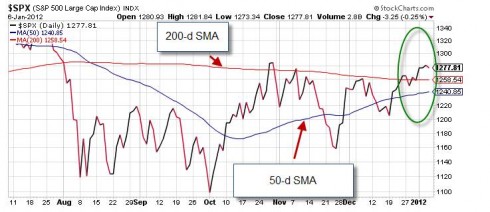
S&P 500 trading above its moving averages
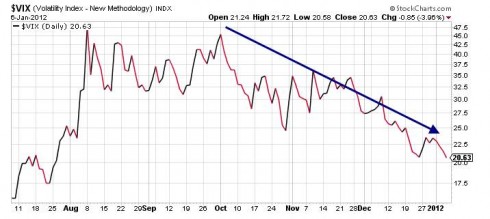
VIX dropping to a calm 20.63
If the current trends continue, an opportunity to take a more aggressive stance with our covered call positions should present itself.
Summary:
IBD: Confirmed uptrend
BCI: Cautiously bullish but leaning towards a more aggressive approach to our covered call positions by increasing our OTM positions.
My best to all,




40 comments… add one
Alan,
Do you give any more importance to this stochastic oscillator than let’s say the macd or moving averages?
Thanks for another informative article.
Fran
Premium Members,
The Weekly Report for 01-06-12 has been uploaded to the Premium Member website and is available for download.
Best,
Barry and The BCI Team
There’s two weeks left in the month and I have some additional cash to invest. Would it be better to buy this months calls or move out to February?
BCI team,
What is the meaning of ” R/R=3″ and “R/R=4” in the comments column of your recent report?
Thanks for your help.
Rob
Fran (#1),
Technical analysis is as much an art as it is a science and not all chartists use it in the same way. I’m happy to let you know how I approach technical analysis. The 4 parameters I have selected to use in the BCI methodology each have a purpose. First I look for an uptrending stock with the 20-d EMA above the 100-d EMA so moving averages get me interested in the stock. Then I use the confirming indicators (MACD, the stochastic oscillator and volume) to predict either a continuation of that trend or a possibility of a change in trend. To a beginner this may seem to be a daunting task but if you set up all charts the same way, you will be reading price charts in seconds. Our premium reports also give a significant amount of technical information on each stock on our watch list. Bottom line: No one technical indicator rules. It is the mosaic which all four portray that guides us to our investment decisions.
Alan
Rob (#4),
R/R =3, R/R=4, etc. indicates the Risk/Reward value for the stock shown. In the BCI methodology, we want to see the Risk/Reward (R/R) at 5 or greater. When a stock has a Risk/Reward (StockScouter) rating less than 5, it fails that specific screen and is eliminated from the current week analysis.
Over the years, many of our readers wanted to know why specific stocks fail a given screen…in this case Risk/Reward. We use the comment spaces to show the actual reading.
In some cases, when a stock is not covered by StockScouter, we will keep it for further analysis if StockScouter indicated that it does not follow that particular stock.
Best,
Barry
Rob (#4) continued,
If the stock shows a R/R <5, we indicated that it failed the Risk/Reward screen with an "N" in the Risk/Reward column. If the stock has a reading of 5 or higher, we show a "Y" in the Risk/Reward column to indicate it passed that particular screen.
Best,
Barry
Frank (#3),
I prefer not to extend my obligation more than 1 month. This allows me to re-evaluate a stock candidate a second time at the end of the current contract. If you look at the options chain below you will see the following for BKI, the first “bold” stock on our premium list:
1- We have a 2-week option return of 2.1% with a downside protection of that profit of 1.4% for the January contract..
2- We have a 5.2%, 6-week return with a 1.4% downside protection of that profit for the February contract. You will note that we can probably do even better by “playing the bid-ask spread”.
If we go with the January contract and the stock is still a viable candidate in 2 weeks, we will most likely generate at least a 3% return for the February contracts. If not, we can move to another security.
Click on the image to enlarge and use the back arrow to return to this blog.
Alan
Alan, this week I read all of your blogs and all of the comments in the archives going back to 11/07, and I took notes. I want to say that I am impressed. I’m pretty stingy about handing out praise but your writing and your answers in the comments section are truly excellent. Your team of Owen and Barry provide good insights as well. In addition, the topics you cover are “spot on.” It’s even more impressive given comments by Owen which indicate you maintain your dental practice at the same time.
I want to read more of your thinking so your books seem like the right place to go next. I’m trying to decide which of your books to start with. I know you’ve commented a couple of times that the type of exits covered are the same but the second book has more exit examples than the third. Given I’ve studied all the blogs and comments, have been an Investools student, have been doing covered calls for awhile, and I think I understand the basics of your exit strategies, would it be appropriate for me to skip the first two books and go straight to the third? If at that point I think I need more exit examples, I would then go to the second book as a follow-up. Thoughts?
I’ll send a separate message to you about becoming a Premium Member including a couple of questions I have.
Really well done. Keep it up!
Steve
Barry,
Thanks for your prompt and detailed responses.
Rob
Steve (9),
Given your background and obvious work ethic and motivation level, your approach is a sensible one. My team and I appreciate and thank you for your generous remarks.
Alan
Alan,
Where can I find infornmation on how to set up a technical chart? Thanks.
Jean
Hi Alan,
In your CTSH chart above where you highlight the SO buy and sell signals, there is another double-dip below the 80% line on the right side (sell signal). How would this affect your decision on what to do with this stock at this point in time?
Thx,
Dave
Jean (#12),
Check page 85 of “Cashing in on Covered Calls” or pages 71-73 of the “Complete Encyclopedia….”.
Alan
Dave (#13),
Excellent question!
In the screenshot below I have highlighted several points with orange arrows. The lowest is the point in time you are referencing with the double dip. Above that, the orange arrow shows a MACD dipping below the centerline, also a bearish signal. Finally the orange arrow on top shows a drop in share price almost predicted by the declining momentum indicators. Note that at this point in time the price is still above the the 20-d EMA. This is an example of a stock that I would either pass on or sell an ITM strike at that point in time. If I was already in a cc position and noted these warning signals I’d be “on alert” to institute an exit strategy opportunity when indicated (20%/10% guideline). Click on the image to enlarge and use the back arrow to return to this blog.
Alan
When printing the weekly stock screen and watchlist, the first letter of the stock symbol does not print on pages 1 and 2. I have tried a number of fixes without success. I am using Windows XP and an HP Officejet.
Thx,
Dean
Dean,
When accessing the report and printing, make sure you highlight “fit to printable area”.
See the screenshot below.
Alan
HANS = MNST:
HANS a stock on our premium watch list changes its ticker symbol this week to MNST:
http://finance.yahoo.com/news/Hansen-Natural-Announces-pz-2701803708.html?x=0
The BCI team
Alan,
I your response to Dave (comment 15) you mentioned macd and moving average. Could you comment on the role of volume in this example.
Thanks a lot.
Rob
Rob,
The changes Dave and I alluded to took place on weakening volume, giving those negative signals less (but not to be ignored) significance. See pages 68-71 for more information on volume. I also plan to wirte a blog article on this subject in the near future.
Alan
Check out NUAN. Just got a 2% 8 day return for the 29 call option.
Good luck.
Eddie
Business Author’s Show:
A replay of a recent radio interview highlighting my new book:
http://www.wnbnetworkwest.com/WnbAuthorsShowBusiness.html
Alan
BCI’ers,
Check out the radio interview using the link in msg. #22…a great interview…really complete explanation. If you want to explain our method to others, you might want to direct them to the interview.
Best,
Barry
Alan,
Great site! There is a lot of value here for the individual investor, especially in the amount of time saved screening for covered call candidates.
ULTA is performing nicely today. Tempted to roll up to the Jan 75 call to allow more upside potential. It’s a risk/reward judgment call… However, I’d be curious to know how you approach these kinds of situations? Are you usually reluctant to roll for a net debit?
Thanks,
GDC
GDC,
Welcome to the BCI community. My preference is NOT to roll up with a net debit in the same contract cycle. This is because there is usually little time for exit strategy execution should the ascending stock decline in value (profit taking for example). What I WILL do frequently is roll out and up for a net debit or credit where I have a full month to manage my position should it turn against me. Another approach would be to close my entire position when the time value of the option premium approaches zero and use the cash to generate a second income stream in the same month. Check pages 264-271 of my latest book (“Encyclopedia…”) for more details on the “mid-contract unwind” exit strategy.
Thanks for your generous remarks.
Alan
Alan, Danielle is a great interviewer and the radio show was excellent. You “covered” all the important benefits and risk associated with the strategy. Is there a way to get a copy of that interview. I would love to download it on my Kindle or audio player and listen to it from time to keep me focus on the strategies. A truly great interview to keep and listen too.
Alan,
I agree with JR. Informative interview. Is it archived anywhere?
Fran
JR and Fran,
Thanks for your kind words. The interview IS archived in the media library of this site:
http://www.thebluecollarinvestor.com/media.shtml
Alan
Premium members:
This week’s 6-page report of top-performing ETFs and analysis of ALL Select Sector Components has been uploaded to your premium site.
For your convenience, here is the link to login to the premium site:
http://www.thebluecollarinvestor.com/member/login.php
Not a premium member? Check out this link:
http://www.thebluecollarinvestor.com/membership.shtml
Alan and the BCI team
MNST:
Formerly HANS, a stock from our premium watch list today announced a 2-for-1 stock split payable on February 15th.
Alan
Sorry for the late question about this topic.
I know the stochastic and MACD oscillators are the two most widely used so I appreciated reading your September MACD article and this one.
I also know that most of the time they provide the same signals at virtually the same time.
So the value of looking at both of them must be for those infrequent occasions when they don’t give the same signal.
So my questions are what’s your sense for how often they don’t give the same signal and what do you conclude when it happens?
I ask because I always wonder if it would be better to use just one since it’s rare they are different and when they are different, I don’t know what to conclude anyway.
Thoughts?
Steve
Steve,
Since the BCI methodology is highly dependent on equity momentum, I am more comfortable using two. When they confirm each other I am more comfortable with strike selection decision. When they conflict I will either avoid the stock or lean to an ITM strike. Take a look at the stocks that passed this weeks screens but show mixed technicals some of which are shown in the screenshot below. As always, I encourage our members to use the indicators they are most comfortable with. You will rarely find two chartists that agree 100% as to which parameters to use and how to evaluate them. Technical analysis is as much an art as it is a science. I share with the BCI community what has worked best for me over the past two decades.
Alan
I have several stocks on my watch list that look ready to go except the stochastic oscillator shows they are over bought. That indicates they are ready to turn around and head down so is it best to hold off buying the stocks for covered call selling?
Thanks
wayne
Wayne,
I have seen stocks remain above 80% for months. I look for dip below or more importantly a double dip below80% for a definitive bearish signal. If all other indicators are bullish I have no problem using these equities. You can also take a conservative position with these stocks by selling ITM strikes.
Alan
Alan, I have been a bit late for this article I know, but I am a little unsure of this indicator from some of the things I have read about it, so hopefully you can clarify some things for me. My first 2 questions I have are:-
-If the slow stochastics has moved up above the O/sold line but has yet to do a MAV cross then could I still take the trade, or is it better to wait for the MAV cross? (opposite also for below O/bought line for a sell trade.)?
– And if I just use the same indicator parameter of “14,3” for the slow stochastics, then wouldn’t this be affected by the volatility changes of markets and perhaps giving off more difficult signals, – then if this parameter was adjusted with the volatility changes? thanks
Adrian,
When it comes to the stochastic oscillator, I do NOT use the trigger (3-day simple moving average) and moving average crossovers for my investment decisions. Because of the constarnt whip-sawing action there are way too many (false) signals. Keeping in mind that the slow-stochastic oscillator is a momentum-based indicator, I use it as a confirming indicator for the moving averages and the MACD histogram. I look for an ascending or descending pattern and in particular crossovers of the 20% and the 80% especially for a second time.
Alan
Alan, so I will just believe then that if this indicator has crossed say above the 20 mark, that this is a good buy signal(and on 2nd time), EVEN if there has not yet been the MAV cross (at this very moment)!
– And I don’t need to adjust the indicator parameter(14,3,3) for any of the markets volatility changes.(as I had read we should do.)
These things again are what I was wanting to confirm, so hope I have this information correct. thanks
Alan, I first wanted to say that I hope you agreed on what I wrote above and under the “support/resistance heading”- as this is now what I have to come to believe!
I just wanted to finish up with 3 final questions on this topic. The last one is a little complex as I once told you, – but all should help me immensely.
– So you had responded with that you “do NOT use the trigger (3-day simple moving average)”, so if this be the case then shouldn’t I take this off of my share charts altogether?( be easier I thought)
– I am wondering if you think I could use a dual(or triple) momentum strategy on ‘just’ the slow stochastics indicator? (The reason I ask is because I have read a trading book from an author(called ‘Robert Miner’ – don’t know if you had heard of him?) who does this using 2(or 3) different timeframe charts, and thinks it makes higher probability trades with cutting down exposure also.) What do you think about this type of analysis for covered calls?
– And if the price breaks above a 20d EMA(or short downtrend line) to reverse trend up, yet the slow stochastics hasn’t crossed above the ’20’ mark – then would you wait for it to go above ’20’ before putting on a trade?,- is this a mixed signal for you, where you now would sell an ITM option – even though price is going up.(opposite also for breaks below a 20d EMA / trendline.)?
Hope you can help me again with some answers.
(ps. I have received the 2 books I ordered from you and am soon going to read them!) thanks
Adrian,
Keeping in mind that there are many approaches as to how to technically analyze a price chart, I’m happy to share my approach:
1- I agree that the trigger for the stochastic oscillator is NOT needed and can be eliminated from your chart parameters.
2- Since we are utilizung short-term time frames for our two confirming momentum idicators (MACD histogram and stochastic oscillator) I belive that it is NOT necessary to examine additional time frames for our 1-month covered call positions.
3- If the price has broken the 20-d ema on high volume in a bullish market environment I would have no problem using an OTM strike. I use the technical parameters of the stock and the market in general to form a mosaic that will dictate investment decisions. If the chart is bullish, the confirming indicators mixed in a bearish market, I tend to favor ITM strikes. I look at the entire picture and then make my decisions.
Alan
Thanks for the answers given above, as it helped me understand using this indicator better. I tried to get the trigger line off stockcharts chart but it wouldn’t work, I may have to try this again later on the free software chart I had used, but when ready to. It’s just as well we don’t need to see the slow stochastics on multiple timeframe charts, as I was going to send another complex question relating to the positions of its use when timing trades!
I will read the books now and try get some more questions answered.
( I also left one under recent article of buyback of options.) thanks